
Next to your existing panels
The built-in AC inverter works with single- and three-phase inverters of any brand.
Sessy has its own built-in inverter, so it works alongside almost any existing solar inverter, single- or three-phase. Choose 5 or 10 kWh and easily add a second or third Sessy later.
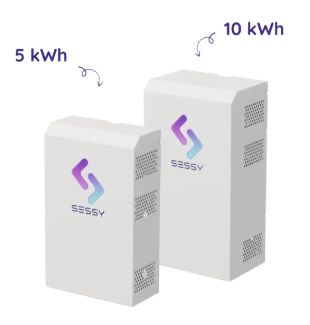
Both versions use the same inverter and software. You get more power by combining several Sessys, optionally spread over the phases.
| Version | Total (kWh) | Usable (kWh) | Charging (kW) | Discharging (kW) | Weight (kg) |
|---|---|---|---|---|---|
| 5 kWh | 5.5 | 5.2 | 2.2 | 1.7 | 46 |
| 10 kWh | 11 | 10.4 | 2.2 | 1.7 | 96 |
Part of the capacity is not used to extend battery life. Dimensions: 41 × 20 × 67 cm (5 kWh) and 41 × 27 × 78 cm (10 kWh).
| Number | Usable (kWh) | Charging (kW) | Discharging (kW) | Active phases |
|---|---|---|---|---|
| 1 | 10.4 | 2.2 | 1.7 | 1 |
| 2 | 20.8 | 4.4 | 3.4 | 1 or 2 |
| 3 | 31.2 | 6.6 | 5.1 | 1, 2 or 3 |
According to the Sessy datasheet. The 5 kWh version has the same power per Sessy.
The built-in AC inverter works with single- and three-phase inverters of any brand.
With 'Zero on the meter' you use as much of your own generation as possible.
In dynamic mode Sessy charges at low and discharges at high prices, if your contract allows it.
App, online portal, local API and cloud API, also for Home Assistant or Homey.
| Expansion | Multiple Sessys can be combined; power and capacity add up per Sessy. |
|---|---|
| Solar panels | Suitable next to existing single- and three-phase PV inverters of any brand. |
| Sessy guideline | Sessy advises one 5 kWh per 3,000–4,000 kWh consumption and the 10 kWh from 5,000 kWh. We calculate your own situation. |
The standard version does not provide backup power. The datasheet mentions a 48 V port for, among other things, a compact backup solution; we only offer it once it is confirmed for your situation.
| Placement | Indoors (IP20), wall mounted or standing, 0–35 °C |
|---|---|
| Noise | 30–40 dBA nominal |
| Efficiency | Round-trip 85% according to Sessy |
| Warranty | 10 years on the battery (6,000+ cycles), 5 years on the inverter |
Further reading: buying questions for all five brands · choosing the right capacity · savings calculator
Sources: sessy.nl/specificaties, Sessy 2.0 datasheets 5 kWh and 10 kWh (sessy.nl, September 2025) and the Sessy FAQ on power. Subject to change. Price and availability after advice.
We compare your consumption, connection and wishes with the five brands we work with and give you a substantiated proposal, without obligation.